

AI Is Doing to ODR What the Internet Did to Mediation
A view from behind the recent film, and why conflict is truly a growth industry.
When I was making the documentary on online dispute resolution, I kept coming back to one question: how did we even get here? And the answer taught me something about where we’re going.
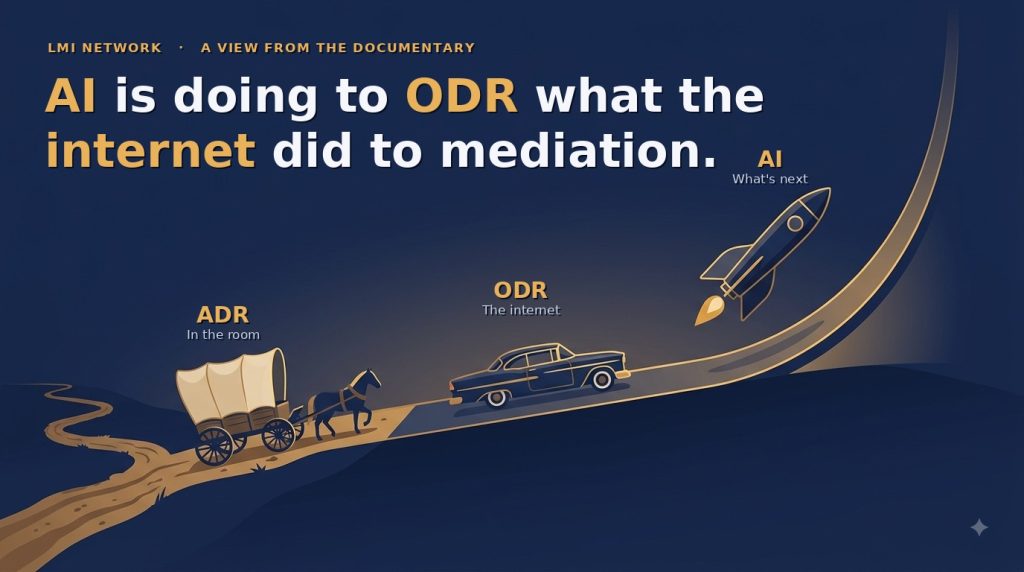
Here’s the short version of the history. A generation ago, mediation and arbitration lived in conference rooms. Then the internet arrived, and it didn’t just move those conversations onto a screen. It created something new. When platforms like eBay suddenly had to resolve millions of disputes a year, far more than any court system could ever touch, they couldn’t hire enough mediators to keep up. So a handful of pioneers, people like Ethan Katsh, Colin Rule, and Leah Wing, built a new field to meet the moment. That field is ODR, online dispute resolution. The internet didn’t digitize mediation. It changed what mediation could even be: asynchronous, borderless, and operating at a scale the old model never imagined.
I’ve become convinced we’re standing at that same kind of doorway again. AI is doing to ODR what the internet did to mediation.
And I mean that in both directions, which is the part I don’t hear enough people talk about.
On one side, AI can make resolution better. It can take the intake paperwork off your desk, surface options a tired human might miss, translate across languages in real time (I lived that at FIMEP in Guadalajara), and help people who could never afford a lawyer get somewhere close to justice. That’s the promise, and it’s real.
But here’s the other side. AI is not only a conflict reducer. It is becoming a conflict generator. We are handing more decisions to agents that act on their own, without a human in the loop, and those agents are going to put people in situations no one signed up for. When an autonomous system makes a promise it can’t keep, or acts on the wrong instruction, who is responsible? That is a brand-new category of dispute, and it is coming fast.
Put those two truths together and you land somewhere that sounds strange to say out loud: conflict is a growth industry. The need for good, humane dispute resolution isn’t shrinking in the age of AI. It’s expanding. New tools, new speed, and also new friction, new misunderstandings, new fights.
The through-line from ADR to ODR to AI-assisted resolution has always been the same goal: give people a better way to resolve conflict without losing the human at the center of it. The internet proved that a new medium can widen the door to justice. AI can widen it further, if we build it on purpose, with our values in the room.
So my question for you this week is the one the documentary leaves open: as AI reshapes conflict itself, are we going to design the next chapter of dispute resolution, or let it design us?
Mac Pierre-Louis is the founder of Zodr.ai, the co-mediator assistant built for Zoom. Part of the LMI Network.
