

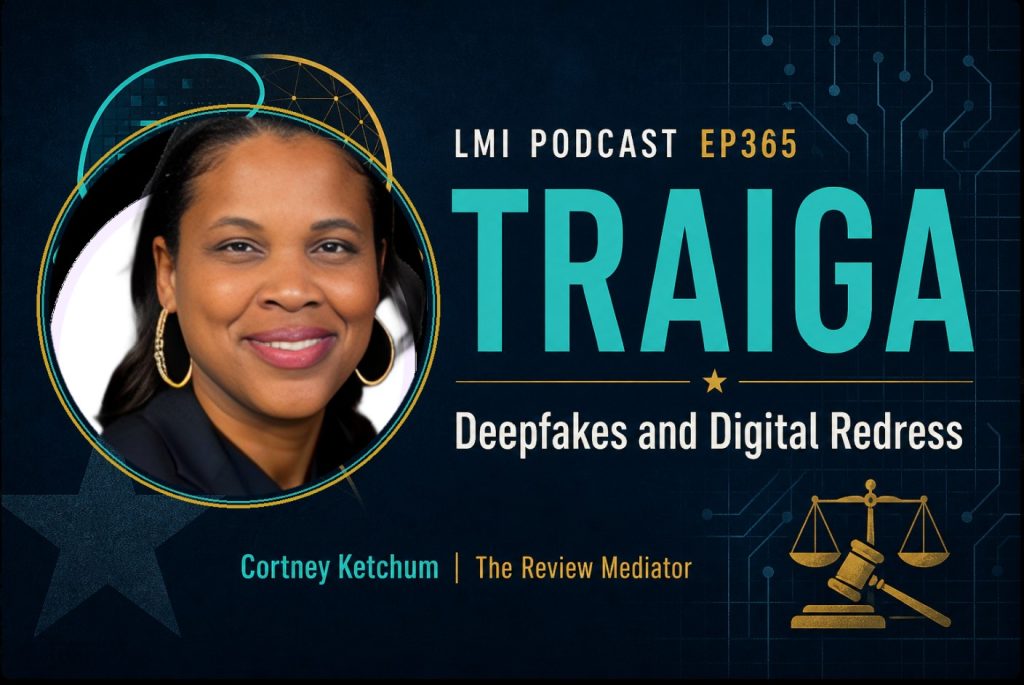
EP365 TRAIGA, Deepfakes, and Digital Redress – Cortney Ketchum on AI Laws and Online Harm
The Intersection of Law, Tech & Conflict Resolution
Cortney Ketchum is back. When she first joined me in 2025, The Review Mediator was helping businesses fight fake and defamatory reviews and review-bombing. In this episode she describes how that work grew into something wider: a digital redress practice for individuals, institutions, and businesses dealing with harmful online content, including AI-generated deepfakes, impersonation, sextortion, cyberbullying, and harassment.
The legal hook is TRAIGA, the Texas Responsible AI Governance Act, which took effect January 1, 2026. Cortney walks through who it actually reaches (not only the company that built the AI, but the organization using it), why the law’s intent standard matters, and why enforcement sits with the Texas Attorney General rather than a private lawsuit. We also talk about Section 230, the Take It Down Act, and the First Amendment line that still sits under all of this: you can say a lot, but you should not be able to use AI to destroy a person’s life or business.
This is education, not legal advice, and it is not a promise of any result. TRAIGA is still new. As Cortney put it, we are all going through this together.
Who is Cortney Ketchum?
Cortney is the founder of The Review Mediator, a Texas-based practice with New Orleans roots. She was last on the show in EP317, Mediating Online Reviews. She is clear that they are not a reputation-management shop. The work is still conflict resolution. The fight just spilled from a private dispute into the public internet.
What changed since EP317
Customers stopped asking only about Google and Yelp. They started bringing viral TikToks, Reddit posts, sexualized posts on X, review-bombing after a video went viral, and then AI-generated harm. Cortney’s phrase for where they landed: a digital redress company helping people resolve issues involving harmful online content.
That work pulled her into tech policy, especially Section 230, the decades-old rule that platforms have used to say they are just the host, not the speaker. Cortney’s view on the recording is that after years of reported harm, that shield is under real pressure, and she pointed to the recent Meta settlement involving the Texas Attorney General and other state AGs as a sign the old immunity is not doing what it used to. Treat that as her read of the news, not a court holding. The case settled, so there is no trial record.
She also described a policy push: governments looking for independent third-party redress companies to evaluate platform decisions on content disputes. That is where she sees The Review Mediator sitting now.
TRAIGA in plain English (from this conversation)
Cortney’s high-level frame: TRAIGA sets rules for how AI can be developed and deployed in Texas. It prohibits certain harmful uses, including intentional discrimination, manipulation that encourages harmful conduct, and certain constitutional harms. Texans can report potential violations to the Texas Attorney General, who has exclusive enforcement. There is a 60-day cure process.
The business point she kept coming back to: you cannot hide behind “we just bought the product.” The law looks at the deployer, the organization actually using the tool, as well as the developer. Know how the vendor built it, how they log incidents, and how they store information, because you may answer for harms it caused.
For lawyers, she flagged the hard part: TRAIGA leans on intent. Did the product intend this harm? That is a different question from impact. A company can show paperwork that they did not intend deepfakes or discrimination, cure the issue, and move on, while the person who brought the complaint may only get the content taken down. Cortney was honest that the law still feels finicky to her: not detailed enough, AG as gatekeeper, and states writing their own AI statutes in part because nobody has settled what to do with Section 230.
Online reviews, she said, have almost taken a back seat to the other fires: deepfakes, sextortion, non-consensual intimate imagery. Those have other statutes, including the Take It Down Act. You can bring a deepfake to TRAIGA, but you still have to deal with intent.
First Amendment, Europe, and a line that stuck
We did not skip speech. Slander, libel, and the First Amendment are why a lot of these laws feel toothless. The European approach, Cortney relayed from a colleague, is the line I will remember: Europeans regulate and Americans litigate. Pros and cons on both sides. We will be having this conversation for a long time.
Three practical steps for a solo mediator or small firm
Cortney’s list, almost word for word:
- Know your vendor. What the tool is designed to do, what data it uses, what safeguards the company has.
- Know your own usage. Which decisions the AI is allowed to influence, and where a human still sits.
- Document everything. What the system is supposed to do, how you use it, problems, comments, and what you did when something went wrong. You do not want the first time you figure out how the system works to be after somebody files a complaint.
Where to go for help
thereviewmediator.com. Cortney walked through an open complaint portal for AI chatbot issues, social platforms (TikTok, Facebook, Instagram), plus Take It Down Act and TRAIGA complaint forms. If you are dealing with online content harm, that is the place she pointed people.
Related: EP317, Mediating Online Reviews, with Cortney Ketchum.
https://lminetwork.com/ep317-mediating-online-reviews-with-cortney-ketchum-of-thereviewmediator-com/
